Translating Your Object
You’ve taken a walk, noticed something specific, and brought that object back, and now you have to shift from finding to translating.
Your task is to identify what made this object stand out and to use those qualities to guide how it will become your sculpture.
1. Observation: What drew you to the object?
Begin by carefully observing your object from all sides. Handle it, weigh it, listen to it.
Ask yourself:
-
What first caught my attention — its form, color, placement, or feeling?
-
Does it have movement or stillness?
-
How does light interact with it — reflect, absorb, cast shadow?
-
What is its scale relative to my body or surroundings?
-
What textures, patterns, or structural details feel essential to its character?
Make quick drawings or photographs emphasizing these features — not to reproduce the object, but to learn what matters most about it.
2. Association: What meanings or memories attach to it?
Beyond form, consider what associations or ideas the object holds.
Sometimes meaning comes not from what it is but from the circumstances of finding it.
Reflect on:
-
Location: Where was it found? Was it visible or hidden? Alone or among others?
-
Gesture: Did you pick it up, uncover it, rescue it, dislodge it, or simply notice it?
-
Context: Is it natural or manmade? Did it seem out of place?
-
Connection: Does it remind you of something or someone? A memory, a feeling, a story?
-
State of being: Is it broken, weathered, eroded, still functional, decomposing, new?
These associations can become conceptual anchors for your translation.
3. Distillation: What qualities will you carry forward?
You can’t (and shouldn’t) reproduce the object exactly. Instead, decide what to preserve, transform, or exaggerate.
Consider:
-
Preserve: What’s essential to its identity? Shape, proportion, texture, posture?
-
Transform: What can be changed to emphasize meaning — scale, material, weight, orientation?
-
Exaggerate: What if you amplify one quality — its smoothness, its density, its awkwardness, its tension with gravity?
Sketch or make quick cardboard studies to test what happens when you simplify or distort the form.
4. Translation: Moving into Material
When you shift into cardboard and cement, you’re moving from found matter to constructed form.
Let the new materials speak back to your object.
Ask:
-
How does cardboard help me understand or map the form (planar, folded, structural)?
-
How can cement reinterpret the object’s essence — heavy/light, fragile/solid, natural/artificial?
-
What happens when time enters — how might this cement form weather, stain, or erode outdoors?
Remember that cement has its own language: weight, gravity, endurance.
Your goal is not imitation, but translation — to create a new object that holds a trace of your encounter, rephrased in another material vocabulary.
5. Reflection: How does your translation hold up to the setting?
Your final object will live among trees, grass, wind, and changing light.
Ask:
-
How will it sit in the landscape — blend, contrast, interrupt, or harmonize?
-
What will happen as it ages — cracks, moss, stains?
-
Does it stand up to its surroundings, or does it yield to them?
Each piece will be a marker of a walk and an encounter — a translation of perception into presence.
6. Technical Translation: Building the Form
Your next step is to decide how your object will take shape.
The method you choose is not just technical — it’s conceptual.
Each process carries a different relationship to your original object: imitation, abstraction, mapping, or transformation.
Below are several possible approaches. You may combine methods, but your final object must:
-
Be between 12”–18” in size
-
Be made primarily of cement
-
Have a piece of metal embedded during casting or finishing so it can be attached to the collective structure
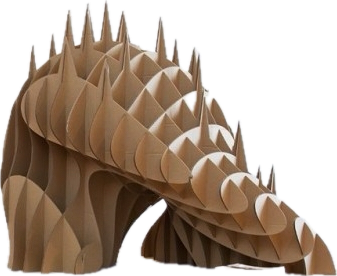
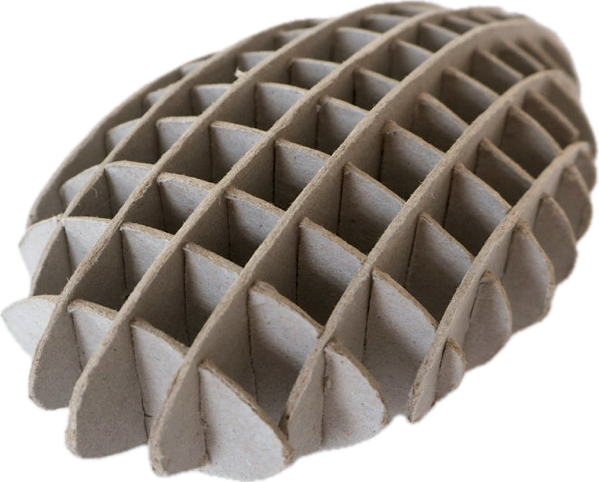
A. Building with Planes (Polygonal / Faceted Construction)
Process:
-
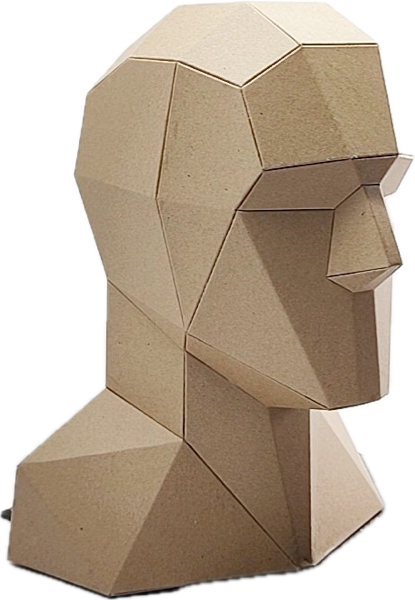
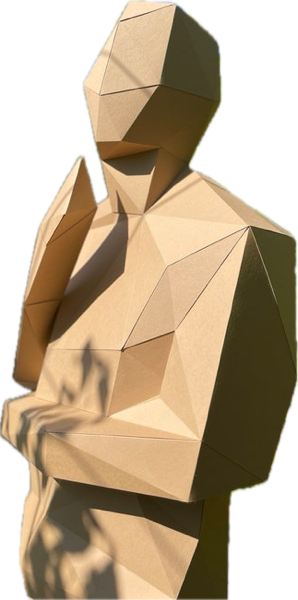
Construct the form from flat cardboard planes — think of how 3D models in video games are made of polygonal surfaces.
-
Simplify the shape into facets that catch light differently.
-
Glue or tape the planes together, then coat the surface with a layer of cement.
Conceptual possibilities:
-
Reducing a natural form into geometry emphasizes translation and mediation — how digital systems or human perception simplify the world.
-
Faceting can highlight how perception breaks the continuous into parts.
-
The contrast between natural inspiration and artificial construction mirrors the tension between landscape and human intervention.
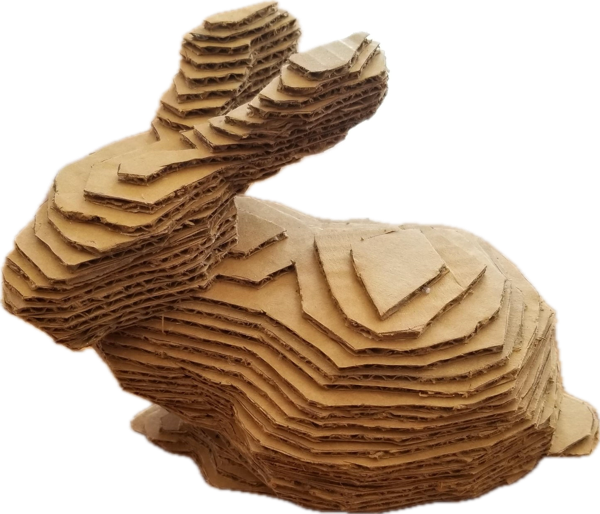
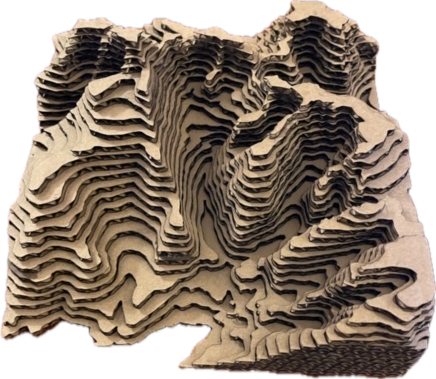
B. Layered Topography (Laminated Construction)
Process:
-
Cut multiple layers of cardboard based on contour lines of the object’s profile.
-
Stack and glue them like a topographic map.
-
Once the form is built, apply cement to unify and define the surface.
Conceptual possibilities:
-
This method mirrors geological formation, sedimentation, and time as a physical process.
-
The visible layers can evoke memory, accumulation, or erosion.
-
Translating the object this way connects human process (cutting, stacking) to natural processes (growth, compression, decay).
C. Direct Casting (Positive Form Reproduction)
Process:
-
Use your found object as a mold form: coat or wrap it with a release barrier and apply a thin layer of cement directly, or press the object into a shallow bed of cement to capture its impression.
-
When it cures, remove the original.
Conceptual possibilities:
-
This method creates a trace or fossil, preserving a moment of contact between object and maker.
-
It captures the surface reality but transforms material and meaning.
-
Think of this as indexical translation — an imprint of presence rather than a depiction.
D. Negative Mold and Cast (Indirect Form Reproduction)
Process:
-
Build a negative form of your object in cardboard or plaster.
-
Pour or pack cement into this cavity, then release it once hardened.
-
The result is a mirror image, a reversal of the original volume.
Conceptual possibilities:
-
Working from absence produces an inverse presence — a ghost, echo, or void made solid.
-
This can relate to memory, loss, or transformation — the object as an afterimage of experience.
-
It foregrounds process over likeness, revealing that every translation carries inversion and change.
E. Plaster Mold and Multiples
Process:
-
Make a plaster mold of your object (single- or two-part).
-
Cast cement into it to create multiples or variations.
-
You can alter each cast with texture, color, or embedded materials.
Conceptual possibilities:
-
Multiplicity and variation invite reflection on difference within repetition — each form the same yet slightly altered.
-
Raises questions about reproduction, seriality, and uniqueness.
-
Recasting can parallel memory’s instability: no two impressions are exactly alike.
Choosing an Approach
Your technical choice should amplify what you found compelling about your object.
Ask yourself:
-
Do I want to capture its exact form, or respond to its qualities?
-
Is my interest in surface, structure, or space?
-
Does my process reflect how I found the object — by chance, by excavation, by noticing?
Practical Notes
-
When applying cement, use layers — the first to bind to cardboard, the next to build form.
-
Reinforce any thin or delicate areas.
-
While casting, embed a short piece of metal (we will go over this in class) so the piece can later attach securely to the group structure.
-
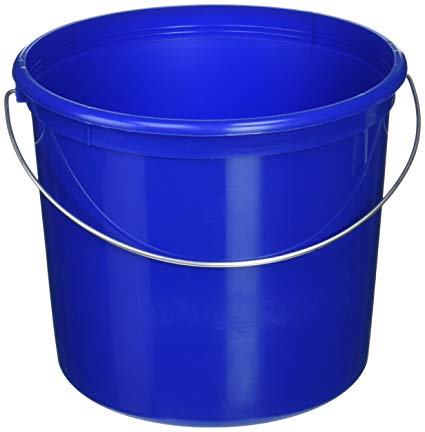
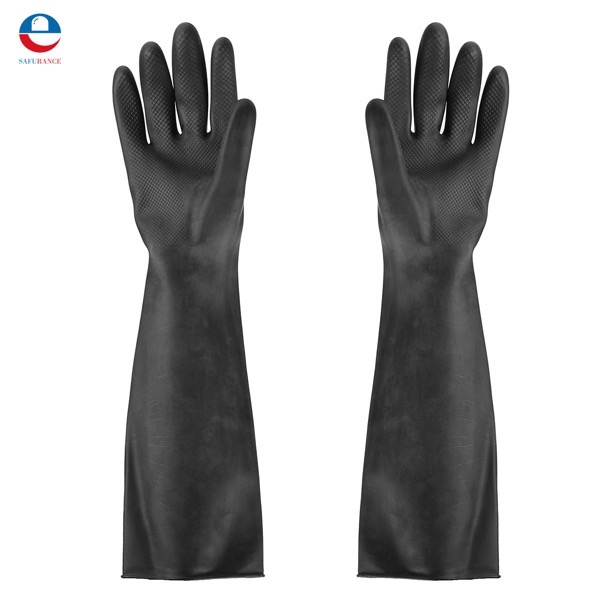
You will need too get these for next week if you dont already have them: Thick dishwashing gloves, a small bucket, and 1or 2 plastic putty knifes: