Transitional Self Portrait
A self-portrait is more than a record of an artist’s appearance. It is a constructed image: a decision about what to reveal, what to conceal, and how to present the self to an audience.
Artists have used self-portraiture to study their physical features, experiment with new materials, record changes in their lives, investigate identity, and express emotions that may be difficult to communicate in words. Because artists can always use themselves as subjects, self-portraiture also provides a practical space for experimentation.
The history of the self-portrait is therefore connected to the history of artistic technology. Mirrors gave artists new opportunities to observe themselves. Oil paint allowed painters to build luminous surfaces, subtle shadows, and complex skin tones. Photography introduced mechanical reproduction and made it possible to capture a particular instant. Video added movement, sound, duration, electronic manipulation, and immediate feedback.
Every new medium changed not only how artists represented themselves, but also how they understood the idea of the self.
The Painted Self
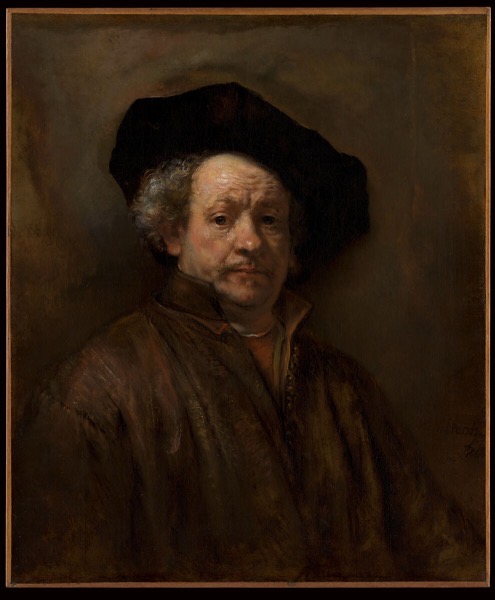
Rembrandt created self-portraits throughout his life. His paintings record changes in his appearance, but they are not neutral documents. Light, pose, clothing, facial expression, and the physical texture of the paint shape our interpretation of the person depicted.
In his 1660 self-portrait, Rembrandt presents himself directly and without idealizing the signs of age. Thick passages of paint emphasize the surface of his face. The image asks us to study both the person and the material from which that person has been constructed.
Expression Rather Than Documentation
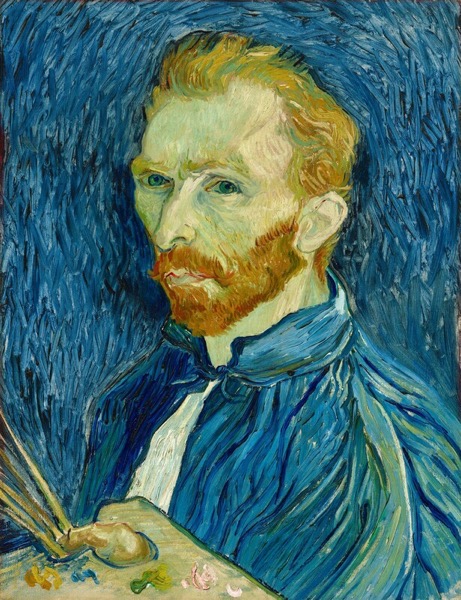
Vincent van Gogh’s self-portraits demonstrate that a portrait does not have to look photographically accurate to communicate something truthful. In his 1889 Self-Portrait, the energetic brushstrokes surrounding his body make the entire image appear to move. His orange hair and beard stand out against a field of intense blues. The palette and brushes identify him as an artist, while the colors and marks establish the emotional atmosphere.
The brushstroke is not simply decoration added to the portrait. It carries meaning. Van Gogh uses the physical behavior of paint to affect how we experience his image.
Identity Through Symbols and Transformation
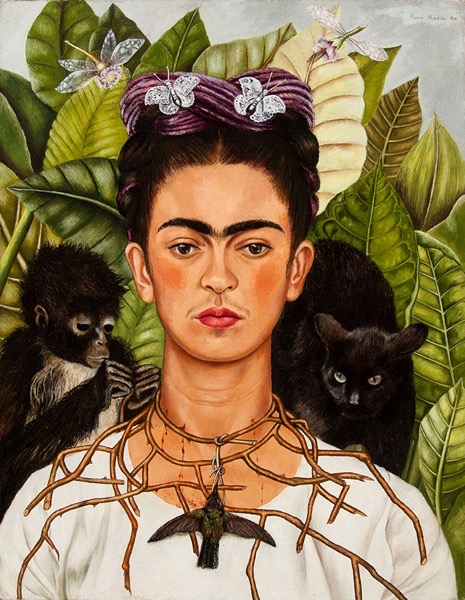
Many artists construct self-portraits through symbols, costumes, settings, and distortions. Frida Kahlo often placed her recognizable face among plants, animals, clothing, wounds, and culturally significant objects. These elements make her paintings more than records of physical appearance. They connect the body to memory, pain, heritage, relationships, and personal mythology.
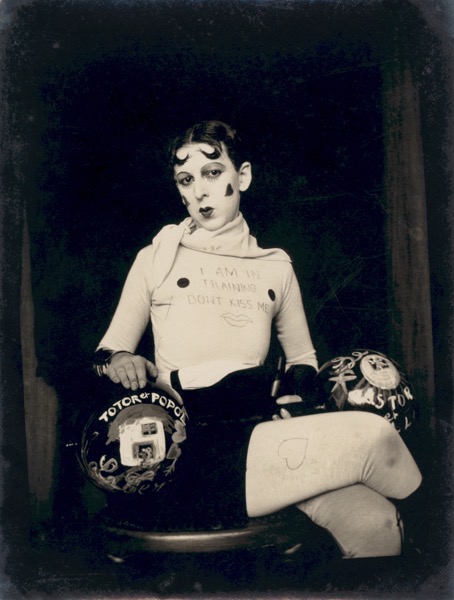
Claude Cahun used photography, costumes, mirrors, masks, and shifting poses to question the idea that identity is fixed. Rather than presenting one definitive self, Cahun performed different versions of the self for the camera. The photograph records a person, but it also documents a transformation.
From Representation to Abstraction
A self-portrait does not necessarily have to include a recognizable face or body. In the twentieth century, artists increasingly used color, gesture, scale, and abstraction to communicate internal experience.
Jackson Pollock’s poured paintings record the movements of his body around the canvas. Mark Rothko used large areas of color to create immersive emotional experiences. These works are not conventional self-portraits, but they can still be understood as traces of an artist’s decisions, movements, attention, and emotional investment.
This expands the meaning of self-portraiture. A portrait might represent what someone looks like, but it might also represent how someone moves, remembers, feels, or experiences time.
The Electronic Self
Video Changes the Portrait
Video introduced possibilities that painting and photography could not provide in the same way. A video portrait can unfold over time. It can include movement, speech, silence, sound, repetition, delay, and transformation. It can show an artist responding to their image while that image is being produced.
Early video artists were working with technology that was still unfamiliar, limited, and imperfect. Their images could be grainy, unstable, distorted, delayed, or interrupted. Instead of treating these qualities only as technical problems, artists used them as creative material.
This approach has an important connection to painting. Painters do not merely select a subject and then apply a neutral technique. The behavior of paint helps create the meaning. In the same way, video artists do not simply record a performance. The camera, monitor, electronic signal, edit, frame, and visual effect can become part of the subject.
The medium helps produce the idea. The medium is the message.
Joan Jonas: Performing with a Malfunction
In Vertical Roll, Joan Jonas used a problem associated with early television monitors. When transmitting and receiving frequencies were out of sync, a dark bar appeared to roll continuously across the screen. Jonas organized her movements around that malfunction.
The rolling image repeatedly fragments her body. Viewers never receive a stable, uninterrupted portrait. The technology alternately reveals and conceals her, making the screen feel like a barrier rather than a transparent window.
The work is about identity, performance, and the representation of women, but those ideas are created through the behavior of the video signal. Remove the vertical roll and the meaning of the performance changes. Jonas made the technological limitation inseparable from the content of the work. MoMA describes the piece as being structured around this television dysfunction.
Peter Campus: Three Transitions
Peter Campus’s Three Transitions is composed of three short video performances in which the artist transforms his own recorded image. The work is a self-portrait, but Campus does not use video simply to show us what he looks like. He uses video effects to make the self appear unstable, divided, replaceable, and temporary.
In the first transition, cameras record opposite sides of a paper wall. The two views are combined while Campus cuts through the paper. The resulting illusion makes it appear as though he is cutting into his own back and passing through his body.
In the second transition, Campus applies blue paint to his face. Chroma key replaces the blue area with another video image, causing a second version of his face to appear beneath the first. The action suggests that one identity is being removed to expose another.
In the final transition, an image of Campus appears inside a blue rectangle. He sets the paper on fire, and the flames seem to consume his recorded face.
Campus uses cameras, compositing, chroma key, color, and live video processing to create the work’s meaning. These effects are not additions used merely to make the video look interesting. Each technique becomes a metaphor for psychological transition: breaking through, covering, uncovering, multiplying, and erasing the self.
The humor of the work is also important. Campus performs each impossible event with an ordinary, controlled manner. The contrast between his calm behavior and the apparent destruction of his body makes the work strange, unsettling, and occasionally funny. The visual effects remain visible enough that we understand we are watching an illusion, but the illusion still affects us.
Technology as Meaning
Today, many effects that required specialized video equipment in the 1970s are available on a phone or laptop. Chroma key, masking, layering, duplication, speed changes, reversed motion, and digital distortion can be created quickly.
Easy access, however, does not automatically give an effect meaning.
A transition is meaningful when the technique and the idea depend on each other. A duplicated figure might express conflicting identities. A mask might separate a public self from a private one. A delay could suggest memory or the gap between an action and our understanding of it. A glitch could communicate anxiety, instability, or resistance to being clearly seen. Reversed footage might represent the desire to undo an experience. A loop could suggest habit, obsession, or being trapped in a repeated role.
Before selecting an effect, ask:
- What does this technology do to my image?
- What idea about identity does that transformation communicate?
- Would the work mean the same thing without the effect?
- Am I using the technique as decoration, or is it carrying part of the meaning?
Transitional Video Self-Portrait Project
Create a short video self-portrait inspired by Peter Campus’s Three Transitions. Your video should use transitions and image manipulation to communicate something about identity, memory, emotion, personal change, or the relationship between your physical and digital selves.
This is not a conventional portrait or a demonstration of editing tricks. The goal is to construct meaning through the capabilities of video.
Project Requirements
Create a video containing three distinct transitions. Each transition should transform your image in a way that communicates an idea about you.
Your three transitions should:
- include your body, face, voice, shadow, reflection, or another recognizable trace of your presence;
- use a different video or editing strategy;
- establish a clear relationship between the effect and the meaning;
- consider movement, duration, framing, sound, and performance;
- work together as parts of one unified self-portrait.
Possible techniques include masking, compositing, chroma key, layering, duplication, split screens, reflections, projection, delayed video, altered speed, loops, reversed footage, jump cuts, match cuts, changes in scale, or intentional digital glitches.
Your transitions do not need to imitate Campus’s three effects. Use his work as a model for thinking about how technology can become metaphor.
Final Reflection
Accompany your video with a short artist statement explaining:
- what aspect of identity your video explores;
- how each of the three transitions contributes to that idea;
- how your use of video affects the meaning of the self-portrait;
- one connection between your project and Peter Campus’s Three Transitions.
What can video reveal, divide, repeat, disguise, or transform about the person I understand myself to be?
Excerpt: peter campus, Third Tape, 1976 from Cristin Tierney Gallery on Vimeo.
Excerpt: peter campus, Four Sided Tape, 1976 from Cristin Tierney Gallery on Vimeo.
Excerpt: peter campus, Dynamic Field Series, 1971 from Cristin Tierney Gallery on Vimeo.